Made to your fan · printed in PETG
Box-fan filter clips
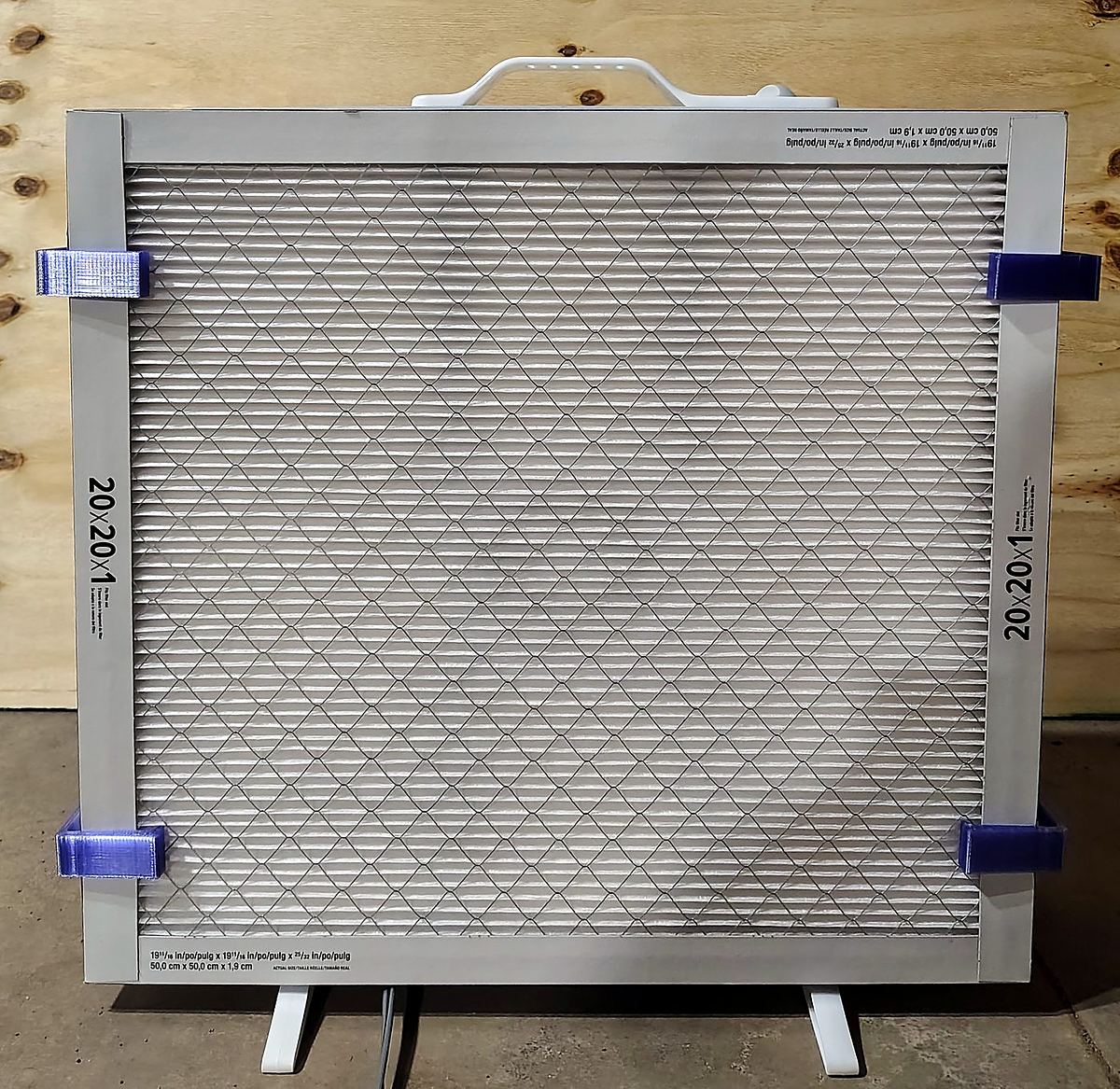
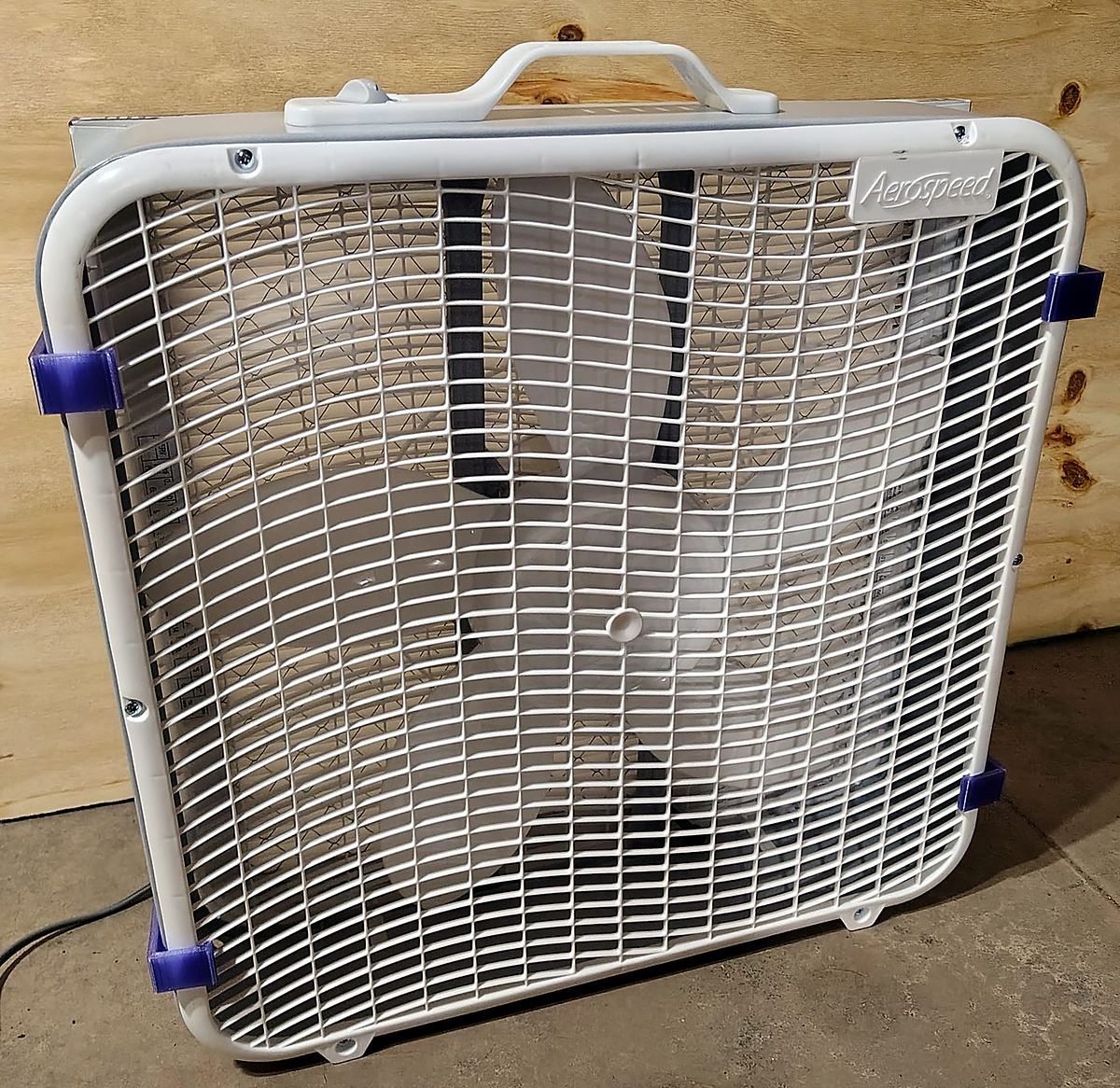
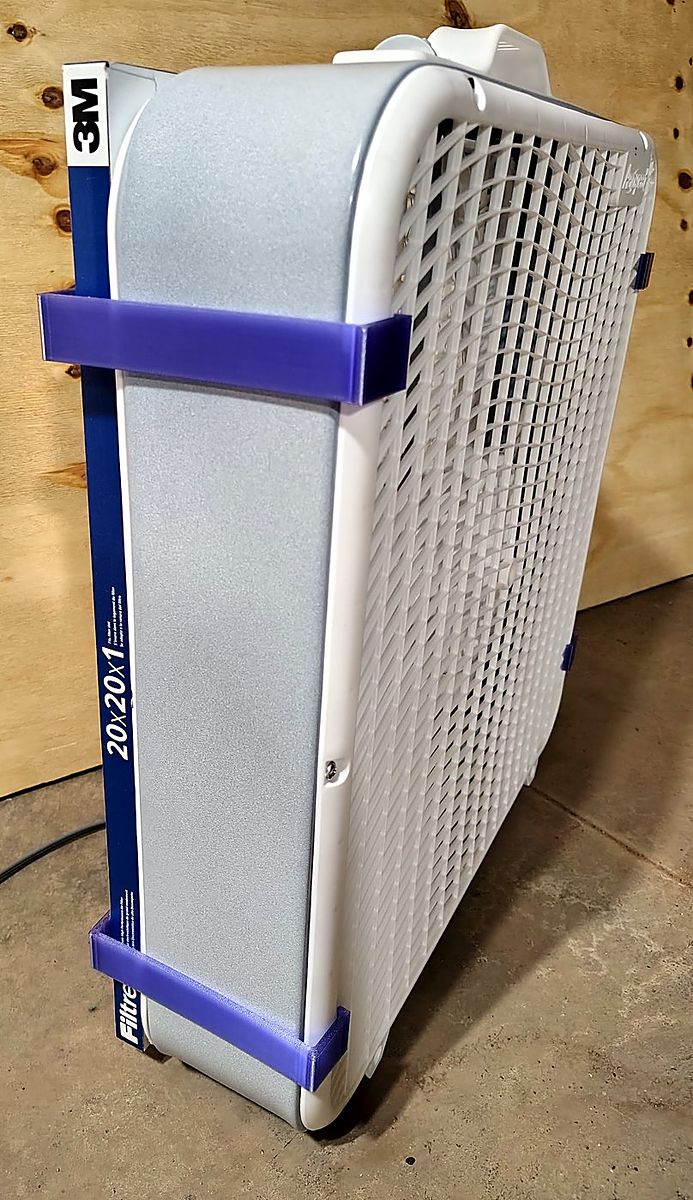
A box fan and a furnace filter make a very good shop air cleaner for about $30 of parts. Holding the two together is the whole problem — tape lets go, bungees bow the frame, and every fan is a different depth. These clips snap over the back rim and hook the filter's cardboard border, and they are cut to your fan's measurements. $15 a set of six, plus shipping.
What it costs
| Six clips, cut to your fanthree a side, PETG | $15+ shipping |
| Singles, or a set of four for a smaller fansame rate, no minimum | $2.50each |
| A 20" box fanAeroSpeed BX100 · Menards SKU 6211117 | $19.99their price |
| A 20×20×1 MERV 13 filterFiltrete 2200 EA02 · SKU 6331722 · three in a box for $29.99 | $10.00each |
| The whole air cleanerand the filter is the only part you ever buy again | ≈ $45 |
If a set comes out wrong against the numbers you sent, I make it again — no charge. That is on me, not on you: you send five measurements, and the clips that come back are cut to them or they are cut again.
Fan and filter prices are Menards' own, checked September 2026 — you buy those wherever you like. I sell the clips.
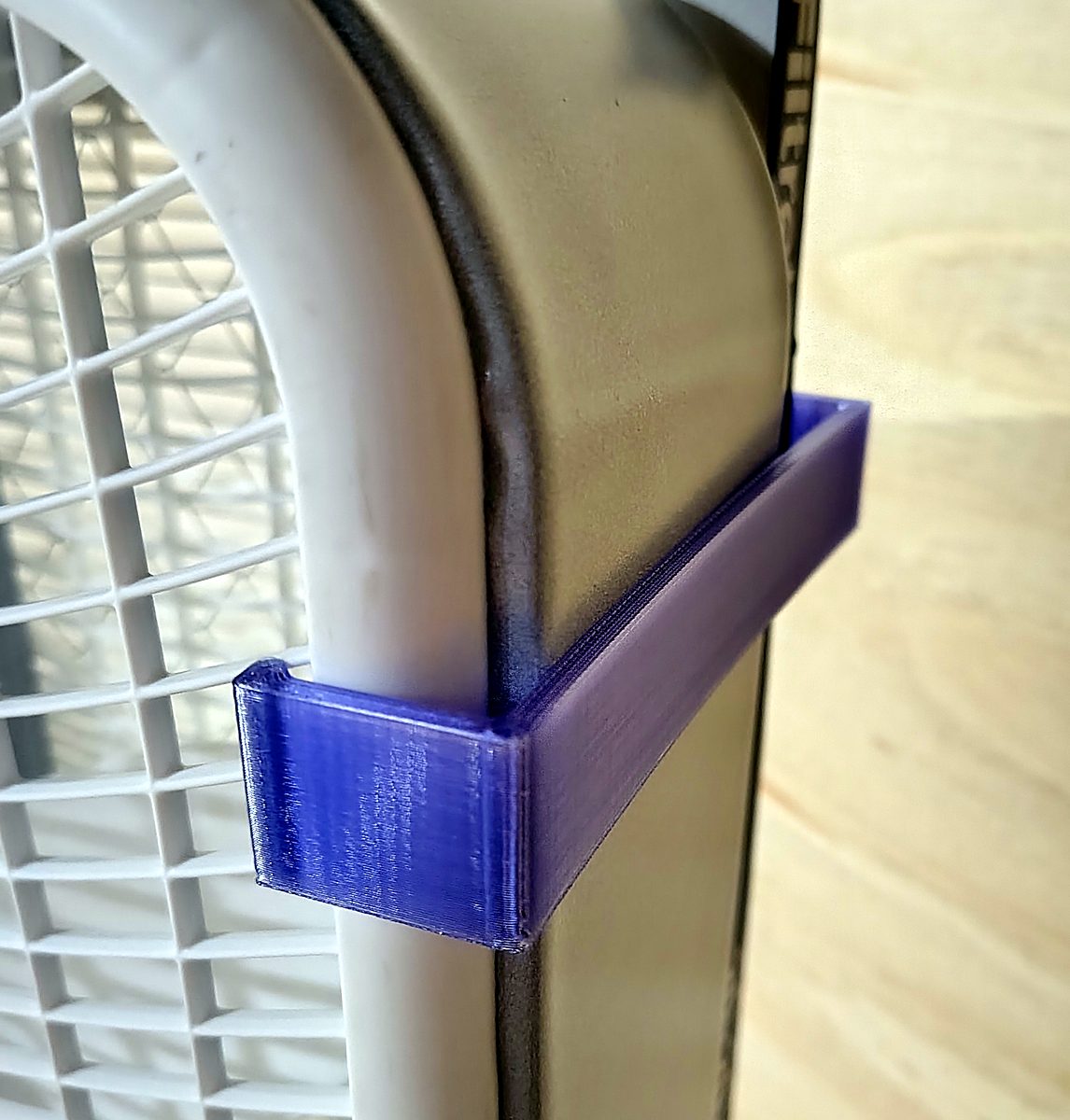
Why buy the clips rather than tape them on. A filter taped to a fan lasts until the tape warms up. These hook the fan's back rim and the filter's cardboard border, and the long tab is drawn a little inside the measured span so pushing it on bends it — that bend is the grip, and it does not relax when the garage hits 90°F.
What you get. Six clips in PETG, not PLA — PLA snaps at the corners of a spring clip, and a fan in a hot garage is exactly where it would. About 160 g of filament and four hours on the machine. I make them after you send the numbers, so tell me if you need them by a date.
The five numbers
Do them in inches or millimetres, whichever your tape reads. Nothing here needs a caliper and nothing needs you to guess which face I mean — every one is the size of a thing, measured across the middle of it. Round to the nearest 1/16".
The housing, across the face, outside edge to outside edge. Not the blades, not the box it came in. A “20 inch” fan usually measures a little over 20.
Tolerance ± 3 mm (1/8"). It sets how many clips you need, and how far the filter sits in from the fan's edge.
The filter itself, across the cardboard. Measure it — don't read the box. A filter
printed 20x20x1 is really about 19¾ inches square, and that three-eighths of
an inch is the difference between the clip hooking the border and hooking fresh air.
Tolerance ± 3 mm (1/8").
On the face of the filter: from the outside edge in to where the pleats start. Usually ¾ to 1 inch of plain cardboard. This is what the long tab has to reach across and hook over, so it is the number that sets the tab's length.
Tolerance ± 3 mm (1/8").
Hold the filter on the fan and measure the thickness of the pair. Back of the fan to the face of the filter, in one go — the easiest way is to stand the fan on its back on a flat floor, lay the filter on it, and measure up to the filter's face.
Check it: measure the fan on its own and add the filter. A “1 inch” filter is really ¾. The two answers should land within 1/16" of each other.
Tolerance ± 1 mm (1/32"). This one is the spring — everything else has room, and this one does not.
On the back of the fan: from the outside edge in to where the grille starts. It is the flat moulded band around the grille, and it is what the short hook grabs. Usually ½ to 1 inch. This sets the hook's length.
Tolerance ± 3 mm (1/8"). The first version of this page assumed every rim was under 5/8" — the fan in the shop turned out to be ¾, and the hook cleared it by under a millimetre. Hence the fifth number.
And two photos. One of the fan's back edge, one of the front with the filter on it. Photographs are what caught the first version of this clip being 8 mm short at both ends; they cost you nothing and they settle any argument about what I measured from.
Does it actually work
Yes, and it has been tested by people who are not selling clips. A furnace filter on a box fan is a well-studied piece of DIY equipment — the multi-filter version is called a Corsi–Rosenthal box — and the two questions people actually ask have answers:
“Will it catch anything?” Use a MERV 13 filter, like the Filtrete 2200 above. That is the rating the research is done on, and it is what separates a filter that catches fine dust from a furnace filter that catches lint.
“Will it strain the fan?” The measurements say no. Underwriters Laboratories tested a filtered box fan under EPA funding in 2021 and found no fire hazard, including under deliberately abusive conditions, and measured power draw on a filtered fan comes out about the same as on the bare fan. ⚠ One filter does load up faster than four sharing the work — which matters a good deal less when changing it takes ten seconds instead of a knife.
Sources: UL / EPA fire-safety testing, 2021; CADR work at UC Davis published in Aerosol Science & Technology, 2022. I have not run these tests myself — I am pointing at the people who did.
One filter, done properly. The build guides call the single filter the minimal version, tell you to duct-tape it to the back of the fan, and then warn that it is best as a temporary measure. The tape is why it is temporary. Tape lets go in a warm garage, it seals badly at the corners, and when the filter loads up you are cutting it off with a knife. Clipped instead, the same build is a permanent fixture: a clean seal the whole way round, and a filter you change in about ten seconds.
One filter or five? The four- and five-filter cube moves more clean air, at four or five times the filter cost — and it is still built with tape. I don't make a kit for the cube. What I make is the single-filter version, held the way it should have been held in the first place.
Where to stand it. Three feet off a wall, filter on the intake side — the airflow arrow printed on the filter frame points at the fan, so the fan pulls through the filter rather than blowing into it.